
Serving Northeast Ohio

(440) 496-6744
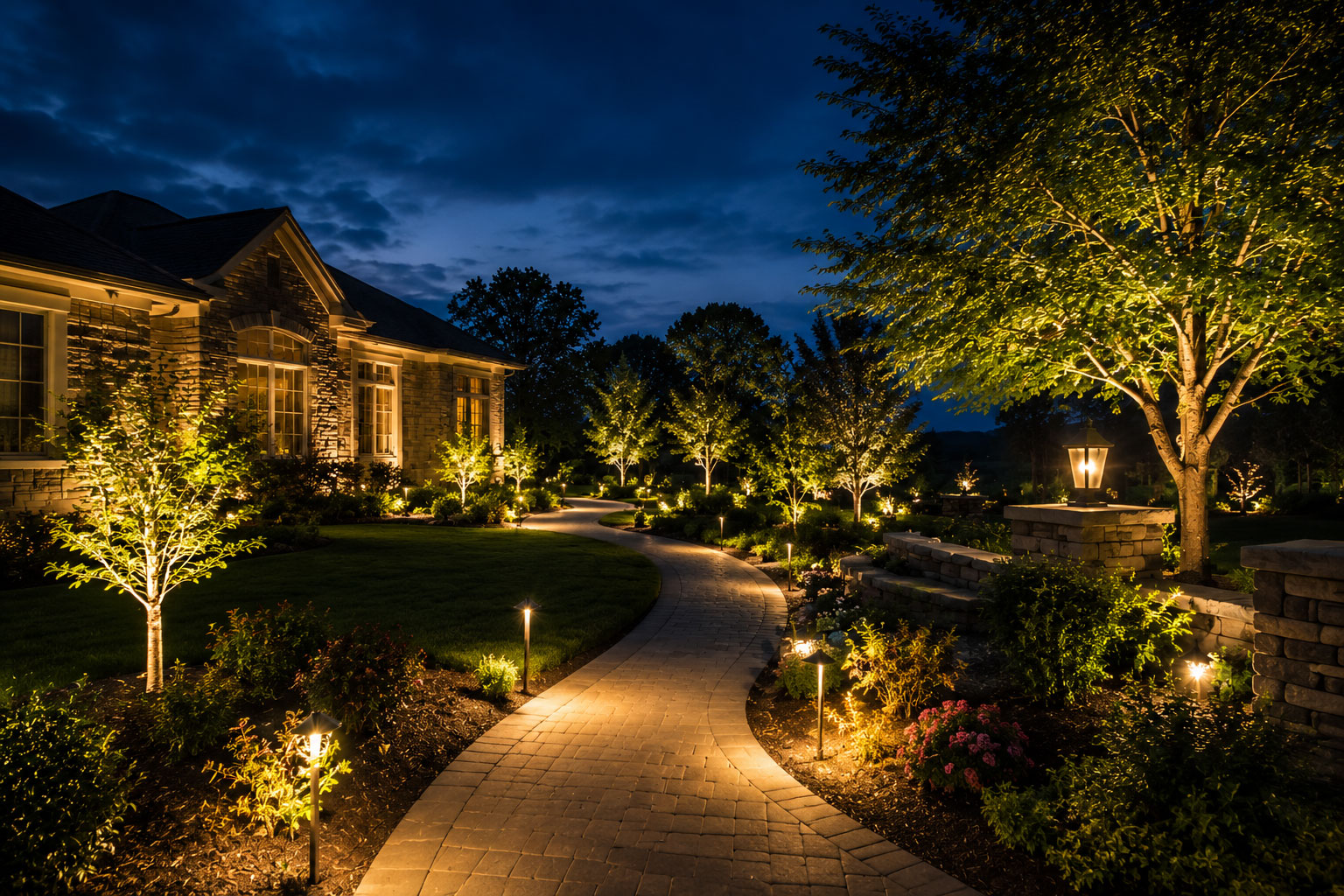
If you've driven through Rocky River, Westlake, or Chagrin Falls after sunset in December, you already know the problem. By 5:00 p.m., Cleveland goes dark. Not "dim," not "dusky" dark. And it stays that way until well past 7:00 a.m. for a solid stretch of the winter. That's roughly a third of the year where most homeowners only see their own front yard in daylight for a few hours on the weekends.
I've spent years installing outdoor lighting systems across Northeast Ohio, and the question I get asked more than any other is some version of "is this actually worth it, or am I just paying for pretty pictures on Instagram?" It's a fair question. Landscape lighting isn't cheap, and nobody wants to drop a few thousand dollars on something that turns out to be more decoration than function.
So let's actually dig into the climate factors, the security angle, the resale conversation, and the stuff nobody tells you until after you've already signed a contract.
Ohio sits far enough north that our daylight swings are dramatic. In late June, we get close to 15 hours of daylight. By late December, that drops to under 9 hours. That's a six-hour swing, and most of it gets carved out of the evening hours when people are actually home to use their yards.
Think about a typical weekday in January. You leave for work before sunrise, you get home around 5:30, and the sun sets at 5:07. Your entire outdoor living space the patio, the walkway, the landscaping you paid a designer to plan out is invisible for roughly seven months of the year unless you've got some kind of lighting doing the work.
This isn't unique to any one suburb. Whether you're in Lakewood with a compact city lot or out in Hudson or Solon with two acres and a long driveway, the daylight math is the same. Landscape lighting isn't about adding something extra to your property. For a huge chunk of the year, it's the only reason anyone including you actually sees your property after you get home from work.
Here's something a lot of homeowners don't think about until they've already bought cheap fixtures from a big box store: our climate is brutal on outdoor electrical components. We get freeze-thaw cycles that can happen a dozen times between November and March. We get lake-effect snow dumps that bury low-voltage path lights for weeks. We get humid summers that invite corrosion into anything that isn't properly sealed.
This matters for the "worth it" question because it changes what you're actually comparing. A $40 solar light kit from a hardware store isn't really landscape lighting, it's a temporary decoration that'll have cracked housings and dead batteries by the second winter. When people tell me landscape lighting "wasn't worth it," in almost every case they're describing a DIY kit that wasn't built for our climate, not a properly designed low-voltage system.
Real landscape lighting the kind installed with buried, direct-burial-rated cable, brass or copper fixtures, and transformers sized correctly for the load is built to handle what a Cleveland winter throws at it. Brass fixtures in particular develop a patina over time instead of corroding, which is one reason we lean on them heavily for anything near the lake or in areas that get heavy road salt exposure in the winter.
I always find it interesting that curb appeal gets mentioned first in most conversations about landscape lighting, when security is usually the bigger driver for people who actually pull the trigger on a project.
Cleveland's suburbs aren't high-crime by national standards, but property crime, package theft, car break-ins, and occasional attempted entries happen in every community, including the ones that feel the safest. Shaker Heights, Bay Village, Strongsville I've done work in all of them, and the conversation is remarkably similar. Homeowners want their property lit not because they're scared, but because a well-lit house is a less appealing target, full stop.
There's actual research behind this. The National Institute of Justice has studied lighting's effect on crime rates for decades, and while the results aren't as simple as "more light equals less crime" everywhere, well-designed lighting consistently reduces opportunistic crime the kind where someone is testing door handles on cars or looking for an easy package to grab off a porch. Motion-activated fixtures near side entrances and driveways do double duty here: they deter, and they alert you (or a security camera) the moment someone's on your property after dark.
A practical note from experience: floodlights alone aren't the answer. I've been to plenty of homes with a single blazing floodlight over the garage that actually makes the rest of the property darker by comparison and creates hard shadows perfect for someone to duck into. Layered lighting a mix of path lights, uplights on trees or architectural features, and some strategic security-focused fixtures does a much better job of eliminating the dark pockets where someone could linger unseen.
Let's talk about the part everyone assumes is the whole story. Curb appeal is real, and it does matter, especially in a market like Cleveland's where a lot of housing stock has genuinely beautiful architectural details: stone facades in Cleveland Heights, craftsman-style homes in Lakewood, brick colonials all over the western suburbs that simply disappear after dark without lighting.
Uplighting a mature oak tree, grazing a stone chimney, or edge-lighting a walkway does something that daytime curb appeal work can't: it changes how your home reads in the evening, which again, given our daylight hours is when most of your neighbors, visitors, and yes, potential buyers if you're ever selling, actually experience your property.
On the resale side, the National Association of Realtors has tracked outdoor lighting projects in their Remodeling Impact Report for years, and it consistently ranks among the higher-ROI outdoor improvements homeowners can make, particularly when it's done as part of a broader landscaping refresh rather than as an isolated add-on. I'm not going to promise you'll recoup 100% of the cost that depends heavily on your home, your neighborhood, and market conditions but it's one of the few outdoor projects that appraisers and buyers notice immediately during an evening showing, which happens more often than people think in a market where showings get scheduled around buyers' work hours.
Cleveland homeowners put a lot of money into outdoor living spaces patios, fire pits, pergolas, outdoor kitchens. And then, functionally, a lot of that investment gets used for about five months a year because once the sun sets at 6:00 p.m. in September, people quietly drift back inside.
This is where landscape lighting has a return that's harder to put a dollar figure on but is honestly one of the biggest quality-of-life upgrades I see with clients. A properly lit patio and fire pit area doesn't just look nice it changes behavior. Families use their outdoor spaces later into the fall. People host more. Kids play in the backyard after dinner instead of being called inside the second it gets dark.
I've had clients tell me, a year after installation, that the lighting is the thing they actually use every single day, more than almost any other part of their landscaping investment, because it's not seasonal in the way a garden bed or a pool is. It works in April and it works in November.
I'll be straightforward about this because it's relevant to whether the investment is "worth it" for your specific situation. A lot of the value in professional landscape lighting installation isn't really in the fixtures you could technically source similar hardware yourself. It's in three things: the design, the electrical work, and the long-term reliability.
Design is harder than it looks. Lighting a property well means understanding how light travels, where shadows fall relative to your sightlines from inside the house and from the street, and how to avoid glare that harsh, blinding effect you get when a fixture is aimed the wrong way and you can see the bulb itself instead of the effect it creates. I see a lot of DIY installs where every fixture points straight up with full intensity, and the result is a yard that looks like a parking lot instead of a home.
On the electrical side, low-voltage systems still need to be sized correctly; the wrong gauge wire or an overloaded transformer leads to "voltage drop," where fixtures at the end of a run are visibly dimmer than the ones near the transformer. It's one of the most common issues I get called out to fix on systems that homeowners installed themselves or that were installed by a landscaping crew doing lighting as an afterthought rather than a specialty.
And then there's the climate piece I mentioned earlier: direct-burial cable rated for our freeze-thaw cycles, connections sealed against moisture intrusion, and fixtures chosen with materials that hold up to road salt if you're near a main road or in a snow-heavy area near the lake.
None of this means DIY is impossible for a small, simple project. A handful of path lights along a straight walkway is a reasonable weekend project for a lot of homeowners. But for whole-property systems, especially anything involving trees, architectural uplighting, or security-focused zones near entry points, the design and installation expertise is where you're actually paying for value, not just labor.
Costs vary a lot based on property size and design complexity, but for context: a modest system covering a front entry and a few key trees or architectural features might run in the low thousands. A comprehensive system covering front and back, multiple zones, security-focused areas, and a patio or outdoor living space can run considerably higher, particularly on larger properties common in places like Hudson, Bainbridge, or Bay Village.
The honest answer to "is it worth it" depends on what you're weighing it against. Compared to a kitchen remodel, it's a fraction of the cost with a much faster installation timeline most residential systems go in over one to three days depending on scope. Compared to doing nothing, you're weighing a modest one-time investment against seven-plus months a year where your property, your security, and your outdoor living space are functionally invisible after work hours.
Whether you go with us or another company, a few things are worth asking any professional landscape lighting installer in the Cleveland area:
Good answers to these questions tend to separate lighting specialists from landscaping companies that added lighting as a side offering.
There's no universal answer, and I'd be skeptical of anyone who gives you one without seeing your property first. But for most Cleveland-area homeowners, the combination of factors is hard to ignore: long stretches of early darkness for most of the year, weather that punishes cheap equipment but rewards well-built systems, real security benefits backed by research, curb appeal that shows up specifically during evening hours when a lot of your home's "visibility" actually happens, and outdoor living space that otherwise sits unused once the clocks change in the fall.
If you're on the fence, the best next step isn't necessarily to commit to a full system right away, it's to walk your property after dark and pay attention to what's invisible right now. The dark walkway. The tree that would look incredible uplit. The side entrance you can't see clearly from the driveway. That walkthrough usually answers the "worth it" question better than any spec sheet can.
Titan Lighting's gallery shows real Cleveland-area properties before and after a lighting design, and our team is happy to walk your yard after dark with you and point out exactly what you're missing right now; you can request a free quote here.