
Serving Northeast Ohio

(440) 496-6744
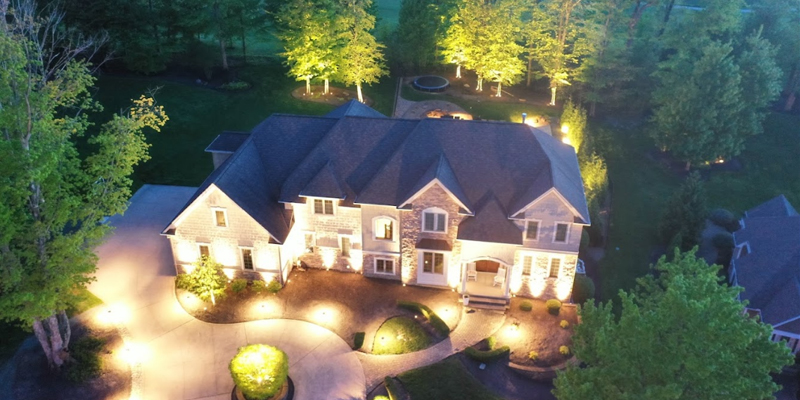
I get asked this question on almost every consultation I run: should we point the lights up at the tree, or down from the branches? Most homeowners have seen photos online of both approaches and can't quite articulate why one house glows warmly while another one looks flat and washed out. The answer almost always comes down to whether the designer used up lighting, down lighting, or — more often than not — a thoughtful mix of both.
After years of walking properties at dusk with a temporary lighting kit, testing angles against a client's brick, their oaks, their front door, I can tell you there's no universal winner — however on an even playing field with no external factors, up lighting is our go-to. Up lighting and down lighting solve different problems. Understanding what each one actually does is the difference between landscape lighting that looks professionally designed and landscape lighting that looks like someone just stuck a few spotlights in the mulch.
Up lighting means placing a fixture at ground level and aiming the beam upward into a tree canopy, along a column, or up the face of your home. It's the technique responsible for those dramatic shots you see of a big oak tree glowing from within, its branches casting shadows against the night sky. The idea is to skim the surface, and while the hot parts of the beam are shot up into the sky, the goal is not to flood an area with light but to accent the existing features — to give a surface character, using the shadow, not eliminating it.
The reason that lighting reads as "dramatic" isn't accidental; it's because we rarely see light travel this direction in nature. Sunlight comes from above. Moonlight comes from above. When light comes from below, our brain registers it as something special, almost theatrical. That's exactly why it works so well on:
I installed a system last spring on a property in the Cleveland suburbs where the homeowner had a hundred-year-old sycamore in the front yard. We used three well lights around the base, staggered slightly so the shadows from the branches fell at different angles instead of overlapping into one flat wash. That tree became the entire personality of the front yard after dark. Neighbors driving by slow down for it.
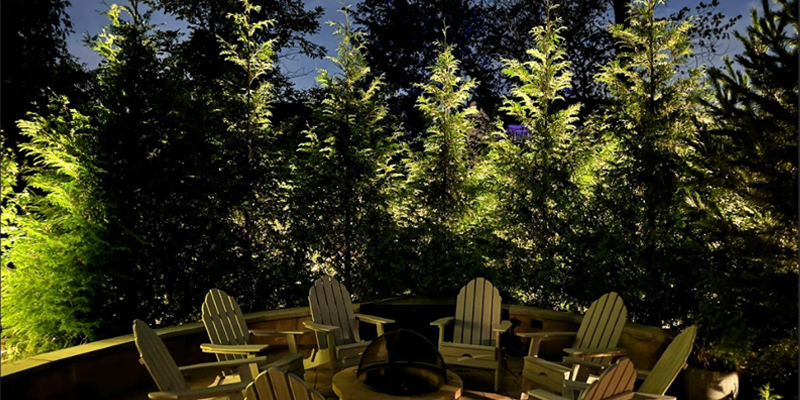
The tradeoff with up lighting is glare. Because the fixture sits at eye level for anyone walking past, a poorly aimed or poorly shielded well light can blind a guest walking up your driveway rather than flatter your landscaping. This is the single most common mistake I see in DIY installations: fixtures aimed too aggressively, with no shielding, so instead of admiring your maple you're squinting at a bare bulb.
Down lighting flips the physics. Fixtures are mounted high — usually in tree branches or under the eaves of the house — and aimed downward. This mimics natural moonlight, which is why in the trade we often call it moonlighting.
Down lighting is the workhorse of practical outdoor lighting. It's what illuminates your pathway safely, softens the shadows across your lawn, and creates that dappled, natural-looking light pattern falling through a tree canopy onto the grass below. Where up lighting says "look here," down lighting says "you're safe here, and this space feels inviting."
Good uses for down lighting include:
A homeowner in Avon, Ohio hired us specifically because her front steps had become a hazard at night. She'd nearly rolled an ankle twice walking to get the mail. We mounted two down lights in the crabapple tree near her front door, angled to wash light across the steps and walkway. It solved the safety issue, and as a bonus, the dappled pattern of light through the branches gave her front entry a completely different character than the harsh porch light she'd been relying on before.
Down lighting is generally more forgiving to install than up lighting because the fixtures sit above eye level, so glare is less of a concern. The tradeoff is that mounting fixtures in trees means running wire up into the canopy, which requires proper support and slack for the tree to grow and sway without damaging the cable.
| Factor | Up Lighting | Down Lighting |
|---|---|---|
| Mood created | Dramatic, bold, architectural | Soft, natural, moonlit |
| Best for | Trees, columns, statuary, facades | Pathways, patios, large canopies |
| Glare risk | Low if positioned correctly | Lower, fixtures sit above eye level |
| Installation | Ground/tree/surface mounted or core drilled lights | Tree-mounted or eave-mounted fixtures |
| Safety function | Minimal | Strong — improves visibility |
| Maintenance | Occasional realignment as plants grow | Requires re-checking mounts as trees grow |
Notice that neither column is objectively "better." A property with only up lighting can feel like a stage set — striking near the house but dark and unwelcoming along the walkway. A property with only down lighting can feel safe but a little uneventful, missing the visual anchors that make people stop and look. The best landscape lighting design almost always layers both.
When I walk through a property for the first time, I'm not thinking "up light versus down light" as a binary choice. I'm asking what job each spot in the yard needs to do. Does this area need to be safe to walk through? Down lighting or path lighting. Does this tree or that architectural detail deserve to be a focal point after dark? Up lighting. Is there a spot that's neither — just background where less is more? Sometimes the right decision is no fixture at all.
A mistake I see constantly with new clients who tried lighting their own yard: they treat every tree the same way. Six trees, six up lights, all aimed the same height, same angle. It reads as busy and repetitive instead of intentional. I'd rather light up two or three specimen trees dramatically and let a couple of others go dark, or light them softly from above instead. Contrast is what makes a lighting design feel designed rather than scattered.
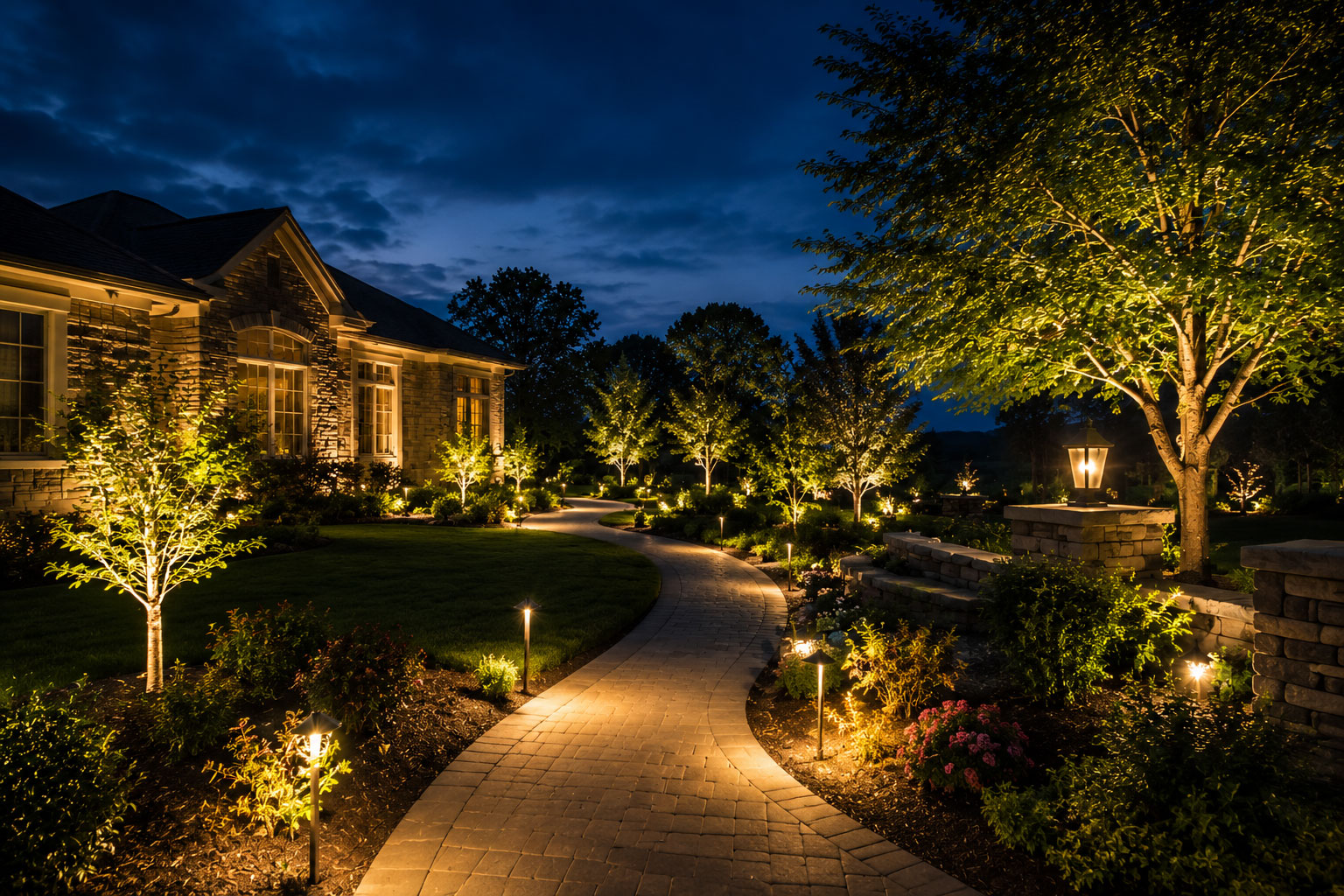
Architectural lighting on the house itself usually benefits from a similar mixed approach. Grazing light up a textured stone chimney draws the eye and shows off the material. Down lighting from the soffits along a covered porch keeps the seating area usable and inviting. Combine both and the house has depth at night instead of just a porch light and darkness everywhere else.
Ohio is not primarily known for its tasteful outdoor night time lighting culture due to our climate and seasonality. For this reason, all of our training and products come from markets like Southern California and Tampa/Miami, Florida, where nighttime landscape lighting is enjoyed year-round and treated as a necessity rather than a seasonal luxury.
Ohio winters and summers are hard on outdoor fixtures, and I think that toughens up the mistakes that show poor planning. A few I run into often:
Fixtures buried too shallow or too deep. Mulch shifts, and a well light that was perfectly aimed in October can be half-buried by spring, throwing light sideways instead of up into the canopy.
No transformer capacity planning. Homeowners add "just one more light" every year until the transformer is overloaded and the fixtures at the end of the run are visibly dimmer than the ones near the house.
Ignoring seasonal growth. A down light mounted in a young tree needs slack in the wire. I've seen wires practically strangling a branch after five years of growth because nobody accounted for it during installation.
Mismatched color temperature. Mixing a warm 2700K bulb with a cooler 3000K or 4000K bulb on the same facade makes a house look unfinished, even if every fixture is aimed correctly.
Landscape lighting isn't installed once and forgotten, and any designer who tells you otherwise isn't being straight with you. Up-lit trees need occasional fixture repositioning as trunks widen and root flare changes the ground level around them. Down-lit canopies need periodic checks to make sure mounting straps haven't girdled a growing limb. LED fixtures last a long time, but connectors corrode, especially with Ohio's freeze-thaw cycles, and a yearly inspection catches small problems before they become a dark section of your yard.
This is one of the practical reasons homeowners lean toward professional landscape lighting installation rather than a big-box kit. It's not just about the initial aim of the fixture, it's about a system built with connectors, wire gauge, and transformer capacity that can handle years of Ohio weather without turning into a patchwork of replaced parts.
If you're standing in your yard trying to decide between up lighting and down lighting, the honest answer is that you're probably going to want some of each. Let your best trees and architectural features get their moment with up lighting. Let your walkways, steps, and gathering spaces feel safe and inviting with down lighting. The properties that stop people mid-walk aren't the ones that picked a side — they're the ones where every fixture is doing a specific job, aimed with intention, and layered so the whole property tells one consistent story after dark.
If you'd like a second pair of eyes on your property, we're happy to walk it with you at dusk and talk through where each technique makes sense for your specific trees, architecture, and the way you actually use your outdoor space. That's the same walk-through we'd do for any homeowner in Ohio considering landscape lighting for the first time — no pressure, just an honest read on what your yard needs.
Up lighting places a fixture at ground level and aims the beam upward into a tree, column, or facade, creating a dramatic, architectural look. Down lighting mounts fixtures high, usually in tree branches or under the eaves, aimed downward to mimic natural moonlight, which is why it's often called "moonlighting."
It can if a fixture is poorly aimed or unshielded, since up lights sit at eye level for anyone walking past. Down lighting fixtures sit above eye level, so glare is less of a concern with that technique.
Most well-designed properties use a mix of both. Let your best trees and architectural features stand out with up lighting, and let your walkways, steps, and gathering spaces feel safe and inviting with down lighting.
Up-lit trees occasionally need fixture repositioning as trunks widen, and down-lit canopies need periodic checks to make sure mounting straps haven't girdled a growing limb. A yearly inspection catches small problems early, which matters given Ohio's freeze-thaw cycles.
Treating every tree the same way — six trees, six up lights, all aimed at the same height and angle. It reads as busy and repetitive. Lighting a couple of specimen trees dramatically and letting others go softer or dark creates the contrast that makes a design feel intentional.